


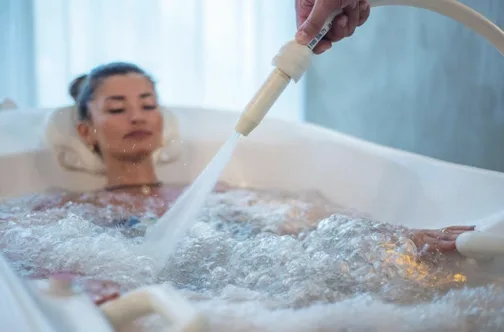
This is one of the most popular methods of treatment and recovery, involving treatment with mineral waters and therapeutic muds. Balneotherapy includes local and general baths, bathing in pools, various types of showers, as well as drinking mineral water, intestinal irrigation and lavage, inhalations, and more.
Above-water spinal traction
What is it?
Above-water spinal traction, or aerotraction, is one of the most effective methods for treating the musculoskeletal system. The therapeutic effect of spinal traction results from the simultaneous combined action of warm bath water and traction on the patient.
Above-water spinal traction has its strongest effect on the lumbar spine. This is supported by a slight reduction in lumbar lordosis caused by lying in the water with the legs extended. Under the influence of stretching, radicular pain stops immediately in many patients.
Indications for above-water spinal traction include various syndromes of osteochondrosis of the lumbosacral spine:
• herniated discs and lumbodynia with neurological manifestations; • lumbosciatica with static and dynamic disorders, expressed as limited spinal range of motion; • scoliosis; • kyphoscoliosis; • flattening of the lumbar lordosis; • radicular compression; • compression radiculopathies; • early manifestations of ankylosing spondylitis; • pseudospondylolisthesis (slippage of the overlying vertebra by no more than one-third of the vertebral body; in the cervical spine, no more than one-fifth);
• deforming spondylosis; • acute and subacute pain manifestations of vertebral syndromes caused by a compressive-mechanical factor, protruding intervertebral discs accompanied by root compression, and entrapment of an intervertebral-joint capsule; • reflex neurovascular, muscle-tonic cervicocranialgia and cervicobrachialgia caused by a mechanical-compressive factor; • neurotrophic and neurovascular disorders of non-radicular origin; • mild, slowly developing radiculomyeloischemic syndromes caused by mechanical-compressive factors in patients with an unchanged or sufficiently wide spinal canal; • complicated pathogenic myofixation of the spinal erector muscles.
Effect of above-water spinal traction
Water at a temperature of 36–37˚ acts on the skin’s nerve endings and helps reduce skeletal-muscle tone, which in turn increases the distance between vertebrae and widens the intervertebral foramina through which the spinal nerves pass. When such a nerve is compressed, for example by osteochondrosis, pain decreases during underwater traction. In addition, reduced muscle tone during underwater traction helps relieve vascular spasm and improve blood supply to the affected area.
Traction in warm water has advantages because its effects are gentler and more physiological. Mechanical spinal traction is combined with the effect of the warm aquatic environment, which helps reduce muscle tone, relax tissues, and lessen pain intensity.